Their story
Buddhist tradition remembers Siddhartha Gautama as the son of a ruling family of the Śākya people, born at Lumbinī, near the present border of India and Nepal. Traditional chronologies place his birth anywhere from the 7th to the 5th century BCE, and many modern historians place his death around 400 BCE, give or take a few decades. His exact dates are unknown.
According to the later biographies, he grew up in comfort and left home at about twenty-nine after encountering old age, sickness, death and a wandering renunciant. The earliest texts tell it more simply: he saw that he, too, was subject to ageing, sickness and death, and went forth to seek what lies beyond them.
He studied meditation under two teachers and then practised severe austerities, which the texts say brought him close to death. Turning instead to a middle way, he sat in meditation beneath a tree at Bodh Gaya and, Buddhist tradition holds, awakened: he understood suffering, its origin, its ending and the path that leads to its ending.
He gave his first teaching to five former companions near Vārāṇasī and then spent some forty-five years walking the towns and villages of the Ganges plain, teaching monks, nuns and lay people of every class. Early Buddhist texts describe him dying at Kuśinagara at about eighty, telling his followers to rely on the teaching and the discipline rather than on any successor.
The world they lived in
The Ganges plain of his time was changing fast: new cities, kingdoms and trade routes, and a crowd of wandering ascetics, the śramaṇas, who left ordinary life to seek release from rebirth. Brahmin priests upheld the authority of the Vedas and sacrifice; Jains, Ājīvikas and others offered rival paths. The Buddha's teaching took shape in conversation with all of them.
Their contribution
He taught that suffering arises from craving and ignorance and can come to an end, and he set out a practical path of ethics, meditation and wisdom leading there. He founded a community of monks and later nuns with a detailed discipline, and admitted people regardless of caste. Tradition holds that he allowed his teaching to be learned in each disciple's own language rather than in a single sacred one.
Teachings and works
No writings
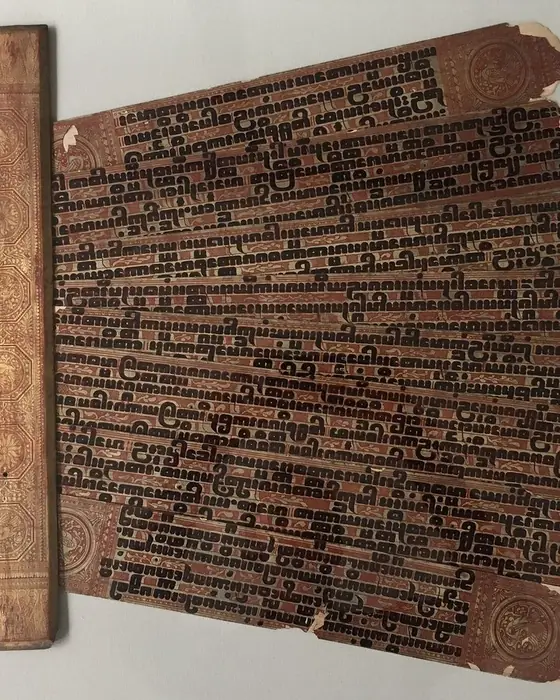
The Buddha wrote nothing. His teachings were memorised and recited by his followers and committed to writing centuries later. The Pāli Canon and the Chinese Āgamas preserve early versions.
The First Teaching (Dhammacakkappavattana Sutta)
Traditionally his first sermon, on the Four Noble Truths and the Middle Way.
Related teachings
Their legacy
Within a few centuries his community had spread across India and into Sri Lanka and Central Asia; within a thousand years, across most of Asia. Every later figure in this collection understood themselves as interpreting, preserving or living out his teaching, however differently they understood it.
History and tradition
What history can establish
Almost all historians accept that the Buddha was a real person who taught in northern India. Beyond that, little can be proved: no inscription or text survives from his lifetime. Emperor Ashoka's pillar at Lumbinī, set up perhaps a century and a half after his death, marks the spot as his birthplace.
What Buddhist tradition remembers
The full traditional biography, with its miraculous birth, palace life, the Four Sights, the assault of Māra and the gods' plea that he teach, was assembled over several centuries in works such as the Mahāvastu, the Lalitavistara and Aśvaghoṣa's Buddhacarita. These stories carry deep meaning for Buddhists, but they are not eyewitness history.