Their story
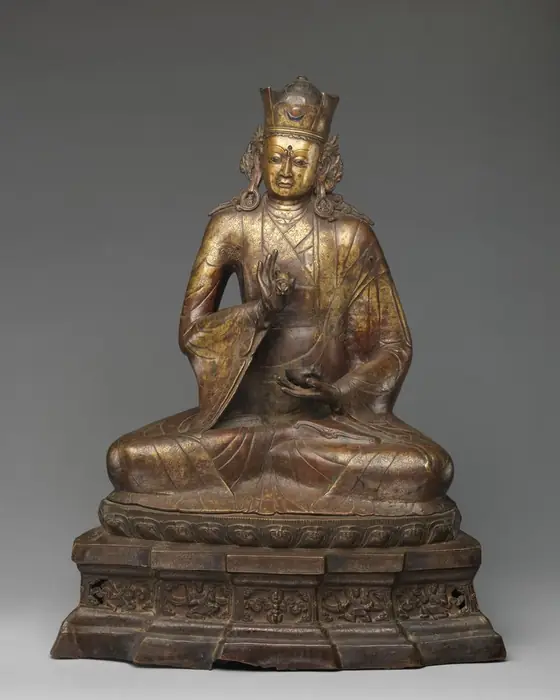
Tibetan tradition remembers Vimalamitra as a great Indian scholar and adept of the Great Perfection, a student of the master Śrī Siṃha, invited to Tibet by King Trisong Detsen in the late 8th century.
At Samye, the tradition says, he translated tantras and taught the Great Perfection to Tibetan disciples, especially Nyangben Tingdzin Zangpo, who concealed his teachings. Several works in the Tibetan canon are attributed to a Vimalamitra.
After thirteen years in Tibet, tradition holds, he left for Wutaishan, the mountain of Mañjuśrī in China, where he is said to remain in a body of light.
The world they lived in
The Great Perfection, which teaches that the mind's own nature is already awakened and needs only to be recognised, took shape in 8th- to 10th-century Tibet, drawing on Indian tantra and possibly on Chinese Chan.
Their contribution
In the tradition, he transmitted the 'Heart Essence' (Nyingthig) teachings of the Great Perfection, later known as the Vima Nyingthig.
Teachings and works
The Vima Nyingthig (Heart Essence of Vimalamitra)
Revealed and compiled in later centuries; attributed to his transmission.
Works in the Tibetan canon attributed to Vimalamitra
Including commentaries; whether all are by the same person is uncertain.
Related teachings
Their legacy
In the 14th century Longchenpa made the Vima Nyingthig one of the four parts of his great compilation, the Nyingthig Yabzhi, and it remains central to Nyingma practice.
History and tradition
What history can establish
A scholar named Vimalamitra is credited in the colophons of texts translated in the imperial period, but his life as told in the Nyingma histories is later tradition.
What Buddhist tradition remembers
Tradition says that he promised to return to Tibet once every hundred years in an emanated form to renew his teachings.