Their story
Almost everything told about Yeshe Tsogyal comes from sacred biographies written long after her lifetime. No source from her own time is known to mention her.
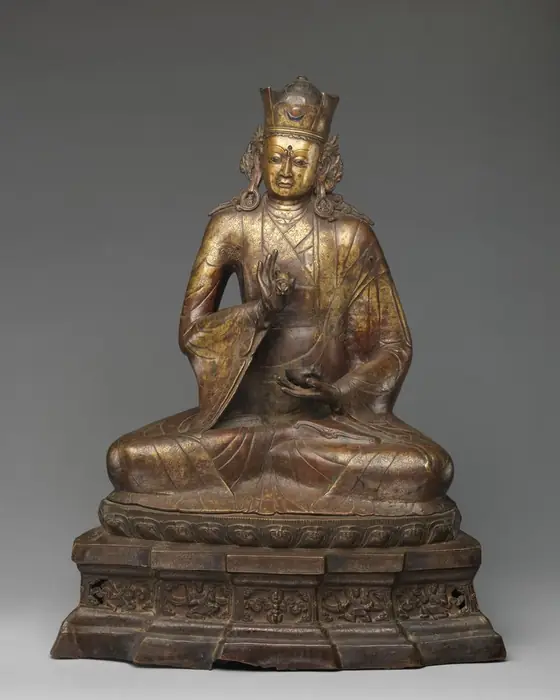
According to those biographies, she was born into the noble Kharchen clan, resisted the marriage her parents arranged, and was taken as a queen by King Trisong Detsen. The king offered her to Padmasambhava, and she became his consort and principal disciple.
The biographies describe years of extreme practice in mountain caves, trials of cold, hunger and assault, and her attainment of full awakening. After Padmasambhava left Tibet, she is said to have taught for many decades, concealed his teachings as treasures for the future and trained disciples of her own.
The world they lived in
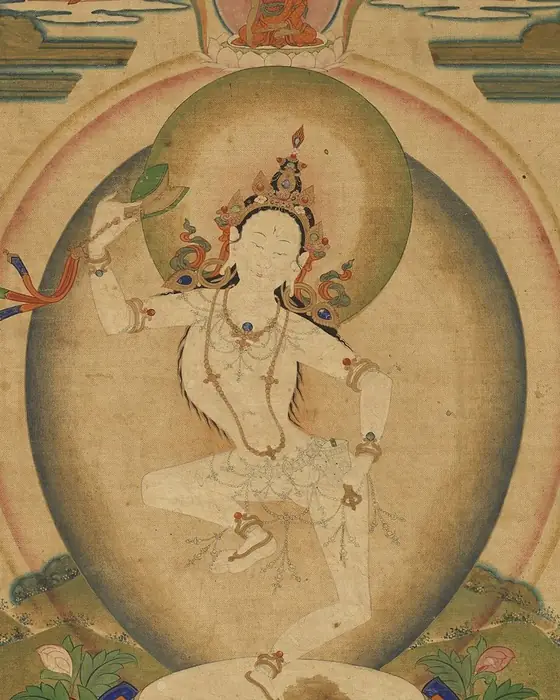
In the Tibetan empire, aristocratic women could hold considerable power, and queens were patrons of Buddhism. Tantric Buddhism gave a sacred place to women as ḍākinīs, embodiments of wisdom.
Their contribution
In the tradition, she is the keeper and transmitter of Padmasambhava's teaching, without whom the treasures would not exist, and proof that a woman can attain the highest realisation.
Teachings and works
Treasure texts attributed to her transcription
Tradition holds that she wrote down and concealed Padmasambhava's teachings.
Related teachings
Their legacy
Her life story is read across the Tibetan world, and many later women teachers were recognised as her emanations. For Buddhist women in Tibet and beyond she remains an inspiration.
History and tradition
What history can establish
Her historical existence cannot be confirmed or ruled out. The earliest accounts of her appear centuries after the 8th century, and her best-known biography was revealed as a treasure text in the 17th century by Taksham Nüden Dorje.
What Buddhist tradition remembers
The biographies say she lived for about two hundred years and at the end departed, in a body of light, to join Padmasambhava in his Pure Land.