Their story
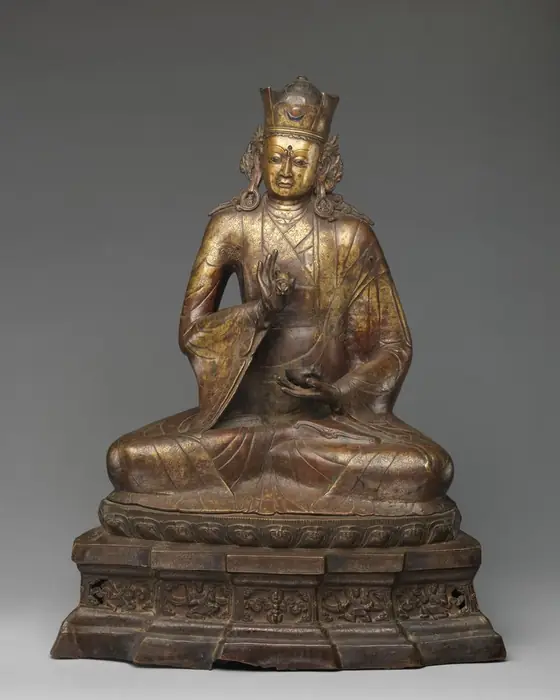
Longchenpa was born in 1308 into a family of Nyingma practitioners and studied from a young age at Sangphu, the leading monastic college of the day, where he mastered philosophy and logic.
Disillusioned by the arrogance and rivalries of the scholars, he withdrew into retreat and in 1335 met his teacher Kumārarāja, a wandering Dzogchen master, with whom he lived in extreme simplicity, receiving the Heart Essence teachings.
Caught up in the conflicts of the period, he spent about a decade in Bhutan, where he founded Tharpaling in Bumthang. He returned to Tibet and died at Chimphu, near Samye, in 1364.
The world they lived in
In the 14th century central Tibet was passing from Sakya rule under the Mongols to the Phagmodrupa dynasty. The Nyingma tradition had no great monastic centre and was often dismissed by the new schools.
Their contribution
He systematised the Great Perfection with philosophical rigour, integrating it with the whole of Buddhist thought, and compiled the Heart Essence lineages into a single collection.
Teachings and works
The Seven Treasuries (mDzod bdun)
The Trilogy of Rest (Ngal gso skor gsum)
Nyingthig Yabzhi (The Four Parts of the Heart Essence)
His compilation of the Heart Essence teachings of Vimalamitra and Padmasambhava.
Related teachings
Their legacy
In the 18th century Jigme Lingpa, inspired by visions of Longchenpa, revealed the Longchen Nyingthig, today the most widely practised Nyingma cycle. His works are studied across schools.
History and tradition
What history can establish
His life and works are well documented.
What Buddhist tradition remembers
Nyingma tradition regards him as an emanation of Mañjuśrī and holds that Vimalamitra's teachings were renewed through him.