Their story
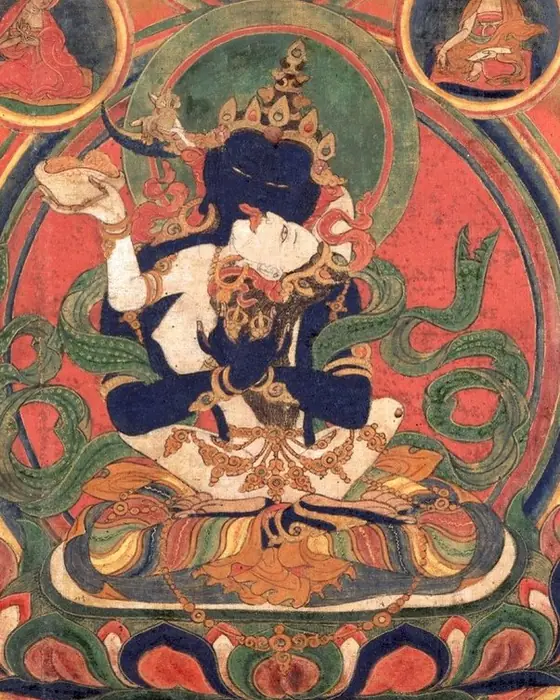
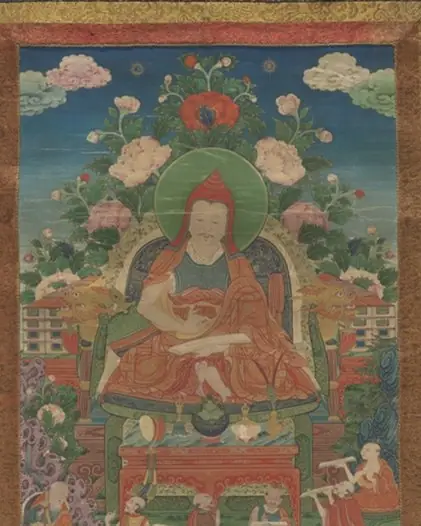
History can say only a little about Padmasambhava. Early Tibetan sources, including the Testament of Ba, describe an Indian tantric master invited by King Trisong Detsen in the 8th century to overcome the spirits and forces blamed for obstructing the building of Samye. They say that his powers alarmed the court and that he left Tibet after a short stay.
Dunhuang manuscripts from perhaps the 10th century already show him as a master of the ritual of the deity Vajrakīla who bound the spirits of Tibet by oath to protect Buddhism.
The great life story came later. Treasure texts revealed from the 12th century onwards tell that he was born from a lotus on a lake in Oḍḍiyāna, raised by a king, practised in charnel grounds, attained immortality, subdued the gods and demons of Tibet one by one, founded Samye, taught twenty-five great disciples and hid teachings across the land for future generations before departing for the Copper-Coloured Mountain.
The world they lived in
Tantric Buddhism was flourishing in 8th-century India, with its rituals of deities, mantras and consecration. In Tibet, Buddhism was a court religion that had to win over powerful nobles and a landscape understood to be alive with powerful spirits.
Their contribution
Whatever the details, his memory stands for the establishment of tantric practice in Tibet and for the idea that Buddhism tames rather than destroys the forces of the land, turning them into its protectors.
Teachings and works
Treasure texts (terma)
Tradition holds that he and Yeshe Tsogyal concealed teachings to be revealed by later 'treasure revealers'. Historians regard these as works of the revealers themselves.
Related teachings
Their legacy
Across Tibet, Bhutan, Nepal and the Himalaya he is venerated as Guru Rinpoche, with festivals on the tenth day of each lunar month. Countless caves, lakes and rocks are said to bear his traces, and the treasure tradition he inspired produced much of Nyingma literature.
History and tradition
What history can establish
Historians accept that a tantric master called Padmasambhava probably visited Tibet in the 8th century, but his importance at the time is debated, and the vast majority of his biography is later sacred literature.
What Buddhist tradition remembers
The Padma thang yig, revealed in 1352, is the best-known of his life stories. Tradition holds that he never died, and that he remains in his Pure Land, the Copper-Coloured Mountain.