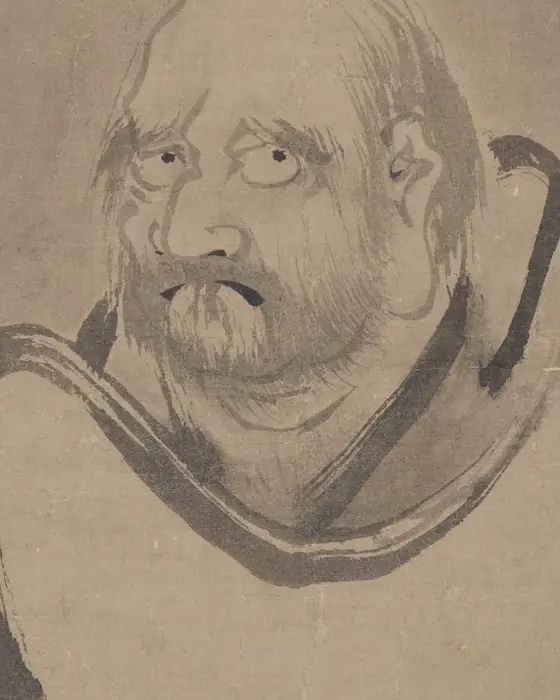
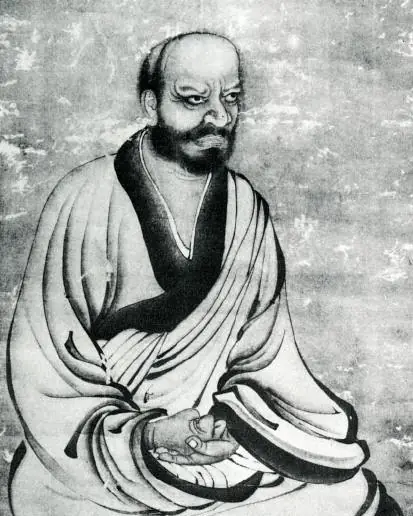
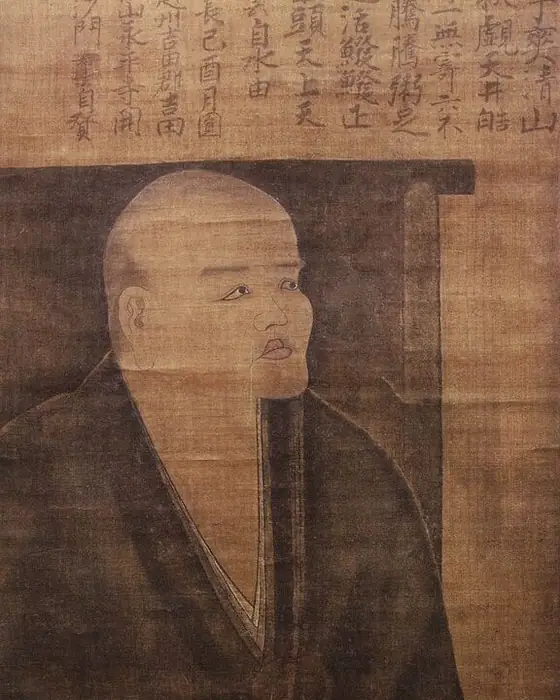
Their story
According to the Platform Sūtra, Huineng was a poor, illiterate seller of firewood in far southern China who heard someone recite the Diamond Sūtra and understood it at once. He travelled to the monastery of the fifth ancestor, Hongren, where he was set to work pounding rice.
When Hongren asked his monks to write verses showing their understanding, the senior monk Shenxiu wrote that the mind is a mirror to be constantly wiped clean of dust. Huineng had a verse written on the wall in reply: originally there is no mirror and nothing on which dust could fall. Hongren secretly gave him the robe and bowl of succession and sent him south.
After years in hiding he was ordained, the story continues, and taught at Caoxi in Guangdong until his death in 713. His body, preserved and lacquered, is still venerated at the Nanhua temple.
The world they lived in
In the early 8th century Chan was becoming a distinct movement, with rival claims to authentic succession from Bodhidharma. Shenxiu's 'Northern School' enjoyed imperial favour in the capitals.
Their contribution
Whatever the historical man taught, the Huineng of the Platform Sūtra teaches that awakening is sudden, that the Buddha-nature is present in everyone, and that meditation and wisdom are one, not stages.
Teachings and works
The Platform Sūtra of the Sixth Patriarch
Presented as his sermons. The earliest version, found at Dunhuang, dates from around 780, and the text was expanded over later centuries.
Related teachings
Their legacy
All later Chan, Seon and Zen schools, including Linji and Caodong, and through them Rinzai and Sōtō in Japan, trace their lineage through Huineng.
History and tradition
What history can establish
A teacher named Huineng seems to have lived in the south, but his rise to fame is largely due to the monk Shenhui, who from 732 attacked the Northern School and championed Huineng as the true sixth ancestor. Scholars see the Platform Sūtra's story as shaped by that campaign.
What Buddhist tradition remembers
A famous story tells that when two monks argued whether a flag was moving or the wind, Huineng told them it was their minds that moved.