Their story
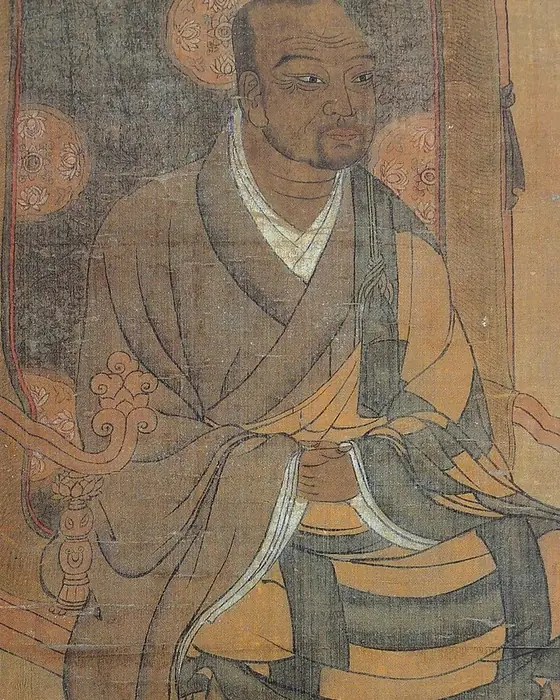
Fazang was born in Chang'an in 643 to a family descended from Sogdian immigrants from Central Asia. He studied with Zhiyan, the second patriarch of the Huayan tradition, alongside the Korean monk Uisang.
He was ordained in 670 and became a favourite of Empress Wu Zetian, for whom he lectured and performed rituals. He took part in the new translation of the Avataṃsaka Sūtra completed in 699.
Tradition says he explained the teaching of interpenetration to the empress using the golden lion that guarded her palace: the gold is like emptiness, the lion's shape like appearances, and each part of the lion contains the whole. He died in 712.
The world they lived in
Under Empress Wu, the only woman to rule China as emperor in her own name, Buddhism enjoyed lavish patronage and was used to support her rule. The long Avataṃsaka Sūtra offered a cosmic vision that suited an age of empire.
Their contribution
He systematised Huayan philosophy: that all phenomena arise together, each containing all others without obstruction, and he ranked the Buddhist teachings with Huayan at the summit.
Teachings and works
Treatise on the Golden Lion (Jin shizi zhang)
Treatise on the Five Teachings of Huayan (Huayan wujiao zhang)
Commentary on the Avataṃsaka Sūtra (Huayan jing tanxuan ji)
Related teachings
Their legacy
Huayan thought shaped Chan, and through his fellow student Uisang it became the Hwaeom school in Korea and the Kegon school in Japan, centred on the great temple of Tōdai-ji. A letter Fazang wrote to Uisang survives.
History and tradition
What history can establish
His life is documented in Tang sources, including a biography written soon after his death, and his major works survive.
What Buddhist tradition remembers
Huayan tradition counts him as its third patriarch and credits him with demonstrating Indra's net with a room of mirrors around a lamp and a Buddha image.