Their story
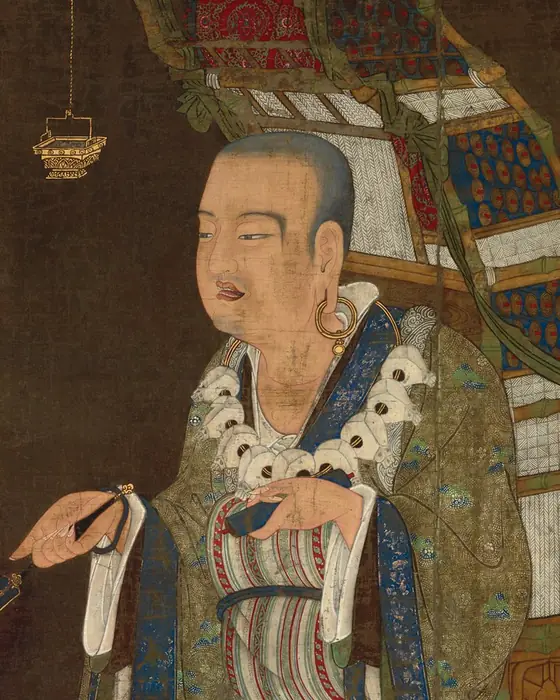
Yijing became a monk at fourteen and, inspired by Faxian and Xuanzang, resolved to go to India. In 671 he sailed from Guangzhou on a Persian merchant ship to Śrīvijaya in Sumatra, a Buddhist kingdom where he studied Sanskrit.
He reached India in 673 and studied at Nālandā for about ten years, recording the details of monastic life: how monks ate, dressed, cleaned their teeth, cared for the sick and chanted. He returned to Śrīvijaya, where he spent years copying and translating texts.
From there, in 691, he sent home his Record of Buddhist Practices and a collection of biographies of Chinese monks who had travelled to India, many of whom died on the way. He returned to China in 695, was welcomed by Empress Wu Zetian, and translated some fifty works, above all monastic codes, before his death in 713.
The world they lived in
The sea route from China to India through Southeast Asia was busy with trade, and Śrīvijaya controlled the straits. Its rulers supported a large Buddhist community, which Yijing recommended to Chinese monks as a place to prepare for India.
Their contribution
He translated the monastic code of the Mūlasarvāstivāda school and recorded, with rare precision, how Indian Buddhist monks actually lived.
Teachings and works
Nanhai jigui neifa zhuan (Record of the Inner Law Sent Home from the Southern Seas)
Da Tang xiyu qiufa gaoseng zhuan (Biographies of Eminent Monks Who Sought the Dharma in the Western Regions)
Translations of the Mūlasarvāstivāda Vinaya and the Golden Light Sūtra
Related teachings
Their legacy
His writings are among the most important sources for the history of Nālandā and of early Śrīvijaya, and his biographies preserve the memory of dozens of forgotten pilgrims.
History and tradition
What history can establish
His travels and work are well documented in his own writings and in Tang records.