Their story
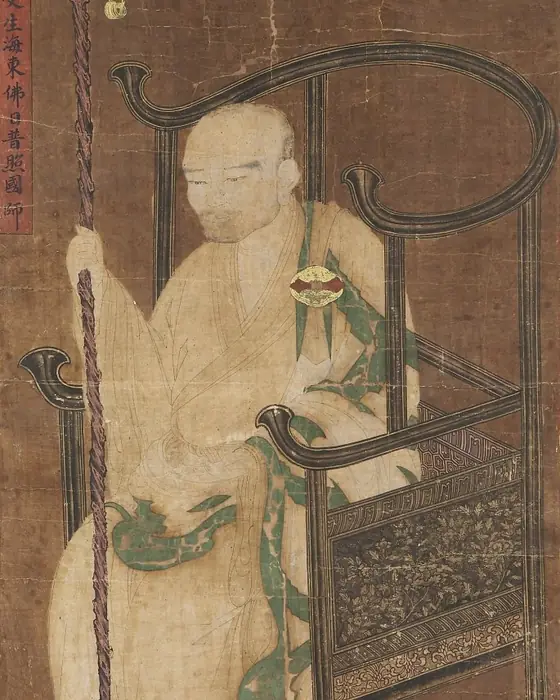
Wonhyo was born in 617 in the kingdom of Silla and became a monk as a young man. With his friend Uisang he twice set out to study in China, where new schools of Buddhism were flourishing.
On the second journey, tradition says, the two sheltered from a storm in what they took to be an earthen hut. In the dark, Wonhyo drank refreshing water from a gourd; at dawn he saw that they had slept in a tomb and the 'gourd' was a skull. He understood that all things arise from the mind, saw no need to seek the teaching abroad, and turned back while Uisang went on.
In Silla he wrote prolifically. Later, according to the Samguk yusa, he broke his monastic vows through a relationship with a widowed princess, and their son, Seol Chong, became a celebrated Confucian scholar. Wonhyo then lived as a layman, travelling among villages and teaching with songs and dances. He died in 686.
The world they lived in
Silla, in alliance with Tang China, conquered the rival Korean kingdoms of Baekje and Goguryeo in the 660s and unified most of the peninsula. Buddhism was the religion of its court, and Chinese schools of doctrine arrived in rapid succession.
Their contribution
Faced with apparently conflicting doctrines, he argued that each captures part of the truth of the One Mind, and that disputes dissolve when each view is understood in its own context. He wrote commentaries on dozens of texts, above all the Awakening of Faith in the Mahāyāna.
Teachings and works
Commentary on the Awakening of Faith in the Mahāyāna (Daeseung gisillon so)
Exposition of the Vajrasamādhi Sūtra (Geumgang sammaegyeong ron)
Ten Approaches to the Reconciliation of Doctrinal Controversy (Simmun hwajaeng non)
Surviving only in fragments.
Related teachings
Their legacy
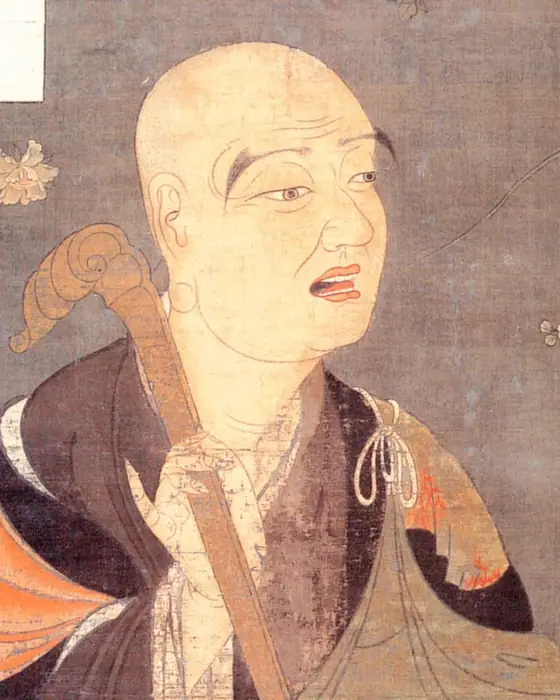
His commentaries were cited by Chinese masters, including Fazang, and revered in Japan, where the monk Myōe honoured him at Kōzan-ji. In Korea he remains a national figure, and his idea of harmony is often invoked today.
History and tradition
What history can establish
His writings, about twenty of which survive of perhaps eighty or more, are securely his. The main biographical sources, a Chinese biography of the 10th century and the Korean Samguk yusa of the 13th, were written long after his death.
What Buddhist tradition remembers
The story of the skull cup appears first in the Chinese Song gaoseng zhuan, compiled in 988, and was later retold many times. Korean tradition also says he danced through the villages with a gourd, singing that 'the unhindered one passes beyond birth and death'.