Their story
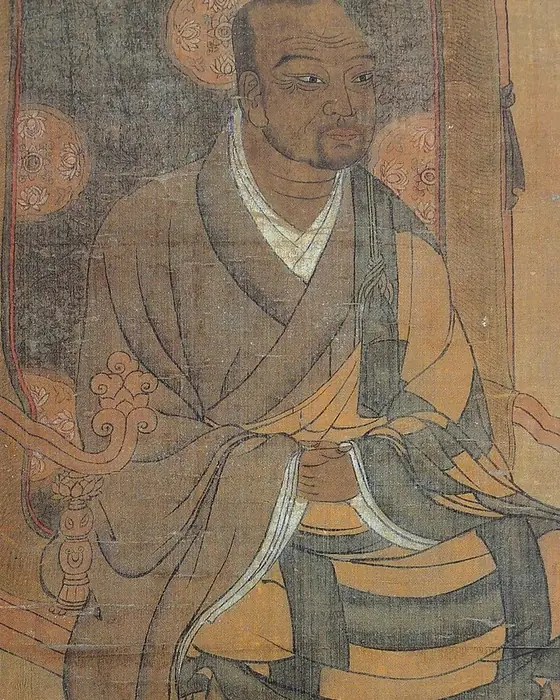
Uisang was born in 625 to an aristocratic family of Silla. After a failed first attempt with his friend Wonhyo, he reached China by sea in 661 and studied for about ten years under Zhiyan, the master of Huayan, on Mount Zhongnan near Chang'an, alongside the younger Fazang.
In 668 he composed his Diagram of the Dharma Realm of the One Vehicle, a poem of 210 Chinese characters written in a winding path like a seal, expressing in a single figure the Huayan teaching that one contains all and all contains one.
He returned to Silla around 670 and, in 676, founded Buseok-sa on royal command, followed by other monasteries. He trained many disciples and died in 702.
The world they lived in
As Silla completed the unification of Korea, its rulers built monasteries to protect the kingdom. Huayan, with its vision of a harmonious whole in which every part reflects the rest, resonated with a newly unified state.
Their contribution
He established Hwaeom as a living tradition in Korea, emphasising practice and devotion, including to the bodhisattva Avalokiteśvara, as well as doctrine.
Teachings and works
Hwaeom ilseung beopgye do (Diagram of the Dharma Realm of the One Vehicle)
Related teachings
Their legacy
Hwaeom became the leading doctrinal school of Silla and Goryeo, and his diagram is still chanted in Korean monasteries. Buseok-sa, one of his foundations, preserves some of the oldest wooden buildings in Korea. A letter from Fazang to him survives, testimony to their friendship.
History and tradition
What history can establish
His life is recorded in Korean and Chinese sources, and his diagram survives. The biographies were written centuries after his death.
What Buddhist tradition remembers
A famous legend tells that a young Chinese woman, Shanmiao, fell in love with him and, when he left, threw herself into the sea and became a dragon to guard his ship home. At Buseok-sa, 'the temple of the floating stone', she is said to have lifted a great rock into the air to drive away those who opposed him.