Their story
Almost nothing about Nāgārjuna's life can be established. Most scholars place him in the 2nd or 3rd century CE, probably in South India, and connect him with the Sātavāhana kings, to one of whom a surviving letter attributed to him is addressed.
He was a monk and a formidable debater, trained in the Abhidharma analysis of the older schools and familiar with the new Perfection of Wisdom sūtras. His core work, the Mūlamadhyamakakārikā or Fundamental Verses on the Middle Way, takes the Buddha's teaching of dependent origination to its limit: whatever arises in dependence on other things has no nature of its own, and so is 'empty'.
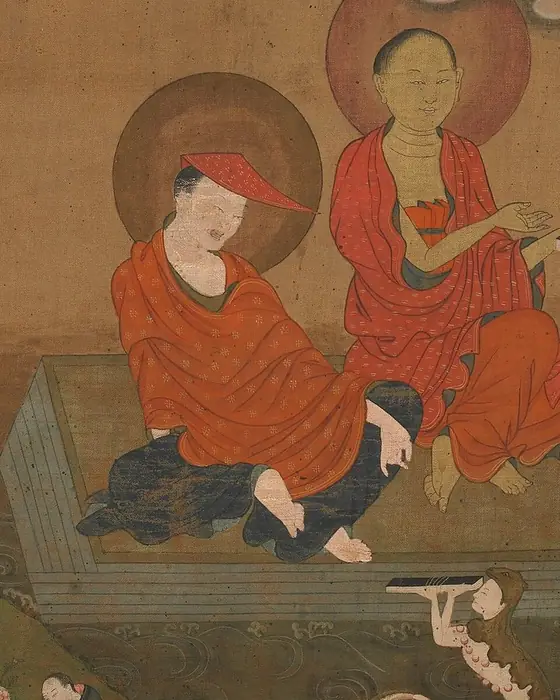
The rest of his life is legend. Later biographies, in Chinese and Tibetan, tell of his mastery of magic, his journey to the realm of the nāgas beneath the sea to recover the Perfection of Wisdom sūtras, and a life of several hundred years.
The world they lived in
In his time the Mahāyāna was a movement within the monasteries rather than a separate school, and new sūtras claiming to be the Buddha's word were circulating. The older schools had built detailed systems describing the ultimate elements of existence. Nāgārjuna's arguments cut against all such fixed systems.
Their contribution
He showed, in rigorous verse arguments, that neither being nor non-being can be affirmed of anything, and that emptiness is not a thing either, but the very fact that things arise dependently. He distinguished conventional truth, by which we live, from ultimate truth, and argued that the two do not contradict each other. This became the Madhyamaka, or 'Middle Way', school.
Teachings and works
Mūlamadhyamakakārikā (Fundamental Verses on the Middle Way)
His one undisputed work.
Vigrahavyāvartanī (Averting the Arguments)
Widely accepted as his.
Ratnāvalī (Precious Garland) and Suhṛllekha (Letter to a Friend)
Letters of advice to a king; traditionally his, and accepted by many scholars.
Many other works
Including tantric texts and treatises on medicine and alchemy, attributed to one or more later people of the same name.
Related teachings
Their legacy
Every later Mahāyāna philosophy defined itself in relation to his. In India, Candrakīrti and others commented on his verses; in Tibet his Madhyamaka is regarded as the highest philosophical view; in China and Japan the Sanlun ('Three Treatise') school grew from Kumārajīva's translations of his works, and Shingon and Chan counted him among their ancestors.
History and tradition
What history can establish
Scholars agree on the Mūlamadhyamakakārikā and a small group of related works. His dates, homeland and life are uncertain, and it is likely that several later authors wrote under his name.
What Buddhist tradition remembers
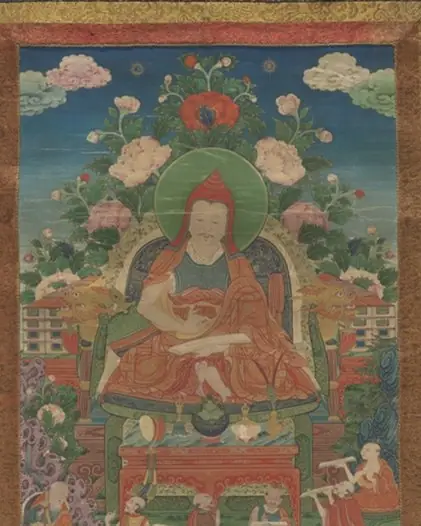
Tibetan tradition holds that the Buddha foretold his coming, that nāgas gave him the Perfection of Wisdom sūtras, and that he lived for six centuries, becoming abbot of Nālandā. The serpent hoods behind his head in Tibetan art recall these stories.