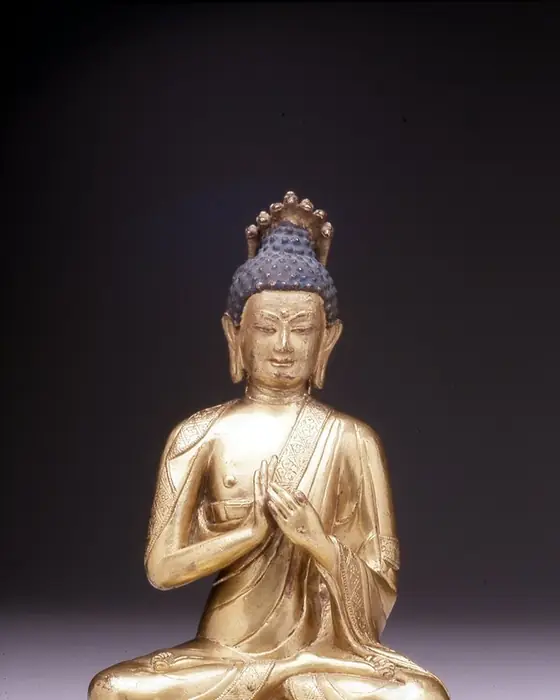
Their story
Āryadeva is remembered as Nāgārjuna's foremost student. His dates are uncertain, but he is generally placed in the 3rd century CE.
Indian and Tibetan tradition say he came from Sri Lanka, some sources making him a king's son who renounced his throne. Chinese tradition knows him as Kāṇadeva, 'one-eyed Deva', because he gave one of his eyes as an offering.
He is best known for his Catuḥśataka, the 'Four Hundred Verses', which begins with the practical errors that keep people bound, such as mistaking the impermanent for the permanent, and moves to the refutation of other schools and the establishment of emptiness.
The world they lived in
In the generation after Nāgārjuna, Buddhist monks debated fiercely with brahmin philosophers and with rival Buddhist schools. Āryadeva's verses are full of these debates.
Their contribution
He extended Nāgārjuna's method into a guide to the bodhisattva's practice, showing how the insight into emptiness should reshape ordinary attitudes to the body, pleasure and the self.
Teachings and works
Catuḥśataka (Four Hundred Verses)
His principal work, preserved in full in Tibetan and partly in Sanskrit.
Śataśāstra (Hundred Treatise)
Known in Kumārajīva's Chinese translation and attributed to him; one of the three treatises of the Chinese Sanlun school.
Related teachings
Their legacy
Candrakīrti wrote a major commentary on the Four Hundred Verses, and Tibetan scholars count Āryadeva with Nāgārjuna as the 'father and son' of Madhyamaka. In East Asia his Hundred Treatise was studied as one of the Three Treatises.
History and tradition
What history can establish
His authorship of the Four Hundred Verses is accepted; his life story is known only from much later traditions.
What Buddhist tradition remembers
A Chinese biography, attributed to Kumārajīva, says he was murdered by the student of a teacher he had defeated in debate, and that he forgave his killer as he died.