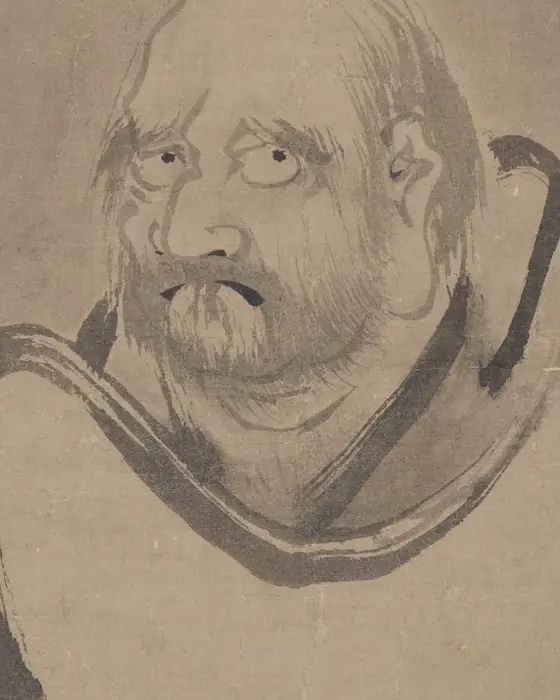
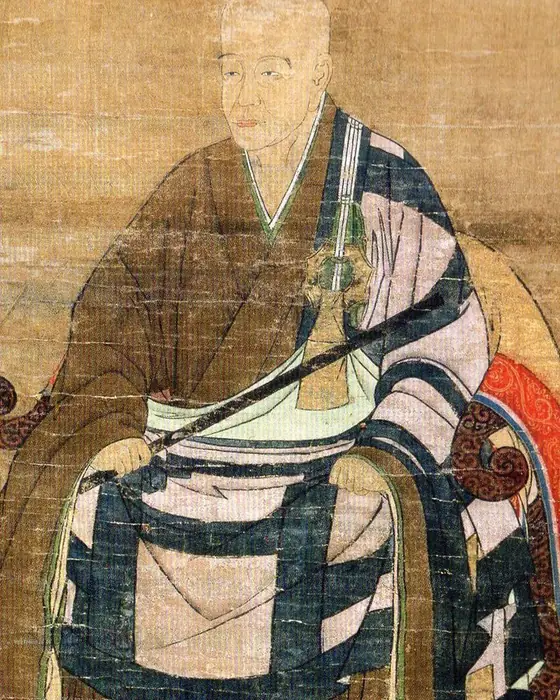
Another self-portrait, with a long inscription above in Hakuin's own brush.

Japanese Buddhist Traditions · c. 6th–18th centuries CE

Hakuin Ekaku

Also known as Hakuin Zenji

1686–1769

Documented dates. Reasonably strong chronological evidence supports this date.

Reviver of Rinzai Zen

Japanese Zen · Rinzai

Hara, Suruga province (Shōin-ji)

Why it matters

He renewed Rinzai Zen through rigorous kōan training and tireless teaching of ordinary people. Almost every Rinzai lineage today descends from him.

View on the timeline

Their story

Hakuin was born in 1686 in the village of Hara, at the foot of Mount Fuji. As a child he was terrified by a sermon on the hells and resolved to become a monk, ordaining at fifteen.

After years of wandering and intense practice, he had an awakening in 1708 on hearing a temple bell, only to have his pride deflated by the hermit teacher Shōju Rōjin, under whom he deepened his realisation. Exhausted by practice, he suffered what he called 'Zen sickness', which he cured, he wrote, with techniques learned from a hermit.

In 1718 he became abbot of the small, poor temple of Shōin-ji in his home village, where he taught for the rest of his life, lecturing widely, writing, and painting thousands of works. He died in 1769.

The world they lived in

In the Edo period Buddhism was state-regulated and temples functioned as registries of households. Rinzai Zen had grown formal and, many felt, spiritually stagnant.

Their contribution

He systematised kōan practice into a course of training, created new kōans such as 'the sound of one hand', and taught lay people through vernacular writings, songs and bold ink paintings.

Teachings and works

  • Wild Ivy (Itsumadegusa)

    His spiritual autobiography.

  • Yasenkanna (Idle Talk on a Night Boat)

    On curing 'Zen sickness'.

  • Song of Zazen (Zazen wasan)

    Still chanted in Rinzai temples.

Related teachings

Kōan practiceThe sound of one handZen art

Their legacy

Modern Rinzai Zen is essentially Hakuin's Zen, and his paintings and calligraphy are treasured as masterpieces of Zen art in museums worldwide.

History and tradition

What history can establish

His life is well documented through his own writings and a biography by his disciple Tōrei.
A self-portrait Hakuin painted in 1767, at about eighty-one. Unlike most figures in this collection, this is how he chose to show himself.
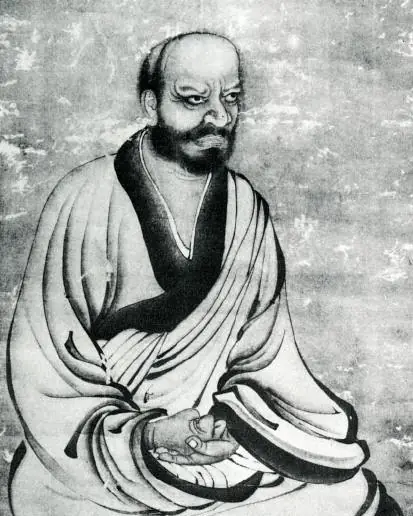
Bodhidharma painted by Hakuin, one of the many bold ink paintings he used as teaching.

Sources and further reading

  • Norman Waddell (translator), Wild Ivy: The Spiritual Autobiography of Zen Master Hakuin. Shambhala Publications, 1999.
  • Katsuhiro Yoshizawa, The Religious Art of Zen Master Hakuin. Counterpoint, 2009.
  • Japanese Zen Buddhist Philosophy. Stanford Encyclopedia of Philosophy.

Image credits

  • Self-portrait, Eisei Bunko Museum, Tokyo. Public domain (a faithful photograph of a public-domain two-dimensional work, as recorded on Wikimedia Commons).
  • Self-portrait, Not recorded by the image source. Public domain (a faithful photograph of a public-domain two-dimensional work, as recorded on Wikimedia Commons).
  • Portrait of Bodhidharma, The Metropolitan Museum of Art, New York. Public domain (The Met Open Access, CC0).

Dharmalogist distinguishes documented history from traditional accounts and later legend. Dates marked approximate or traditional should be read as ranges, not points.