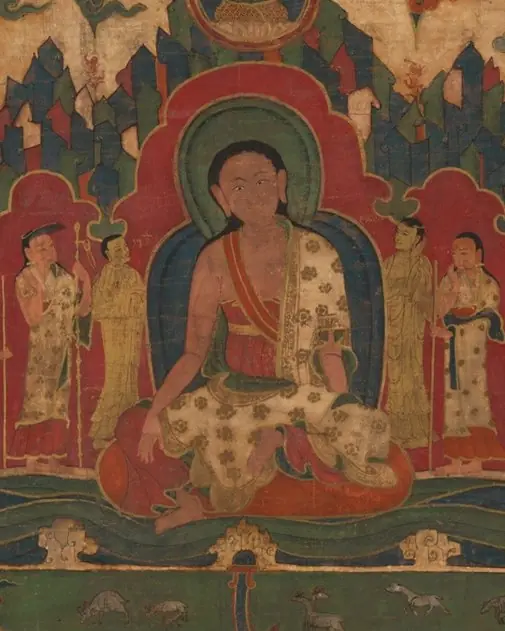
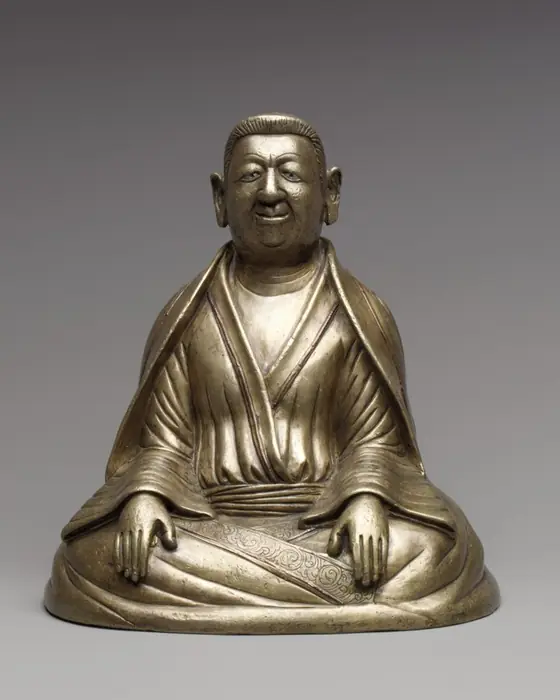
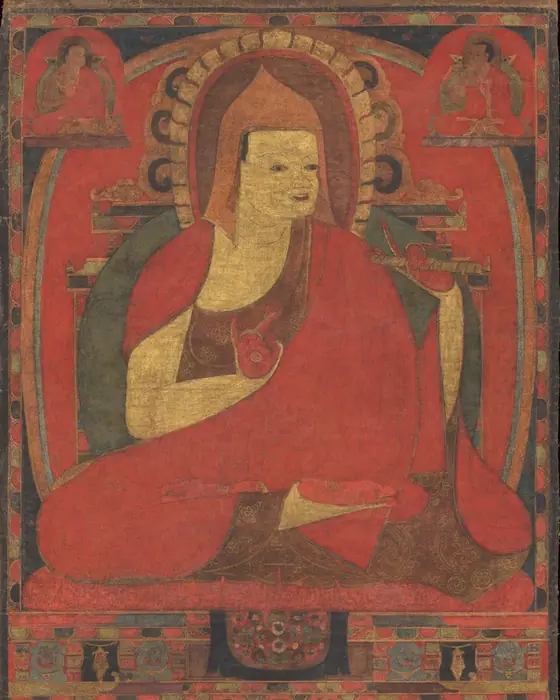
Their story
Gampopa was born in 1079 and trained as a physician. When his wife and children died in an epidemic, he became a monk and studied in the Kadampa tradition founded by Atiśa's followers.
Hearing of Milarepa, he sought him out and studied with him for some months, receiving the teachings of Mahāmudrā and the Six Yogas. Returning to practise, he attained deep realisation.
In 1121 he founded the monastery of Daklha Gampo, where he taught large numbers of students until his death in 1153.
The world they lived in
In 12th-century Tibet, the Kadampa monasteries emphasised discipline and gradual study, while yogic lineages such as Milarepa's emphasised direct realisation in retreat. Gampopa belonged to both worlds.
Their contribution
He united the two, teaching Mahāmudrā within a framework of monastic ethics and the graduated stages of the path, and made it accessible even to those without tantric initiation.
Teachings and works
The Jewel Ornament of Liberation (Dam chos yid bzhin nor bu thar pa rin po che'i rgyan)
Related teachings
Their legacy
His disciples founded the 'four major' Kagyu schools, including the Karma Kagyu of Düsum Khyenpa, the first Karmapa, and the Phagmodru, which gave rise to several more. His Jewel Ornament remains a standard introduction to the Buddhist path.
History and tradition
What history can establish
His life and works are well documented in Kagyu sources, some written by his own disciples.
What Buddhist tradition remembers
Kagyu tradition holds that the Buddha foretold his coming in the King of Samādhi Sūtra.