Their story
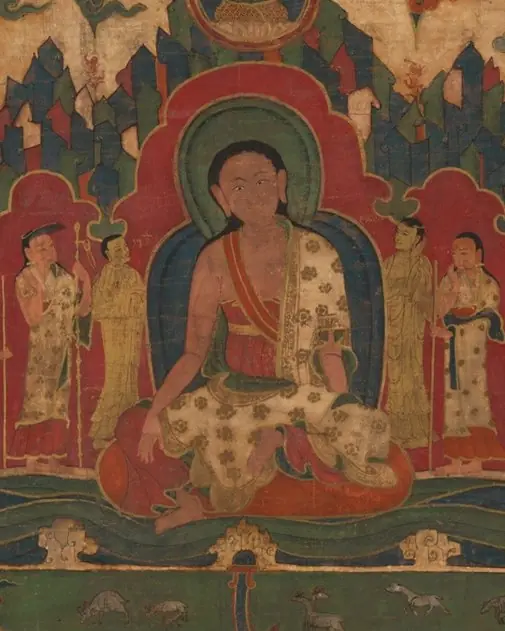
Marpa was born in Lhodrak in southern Tibet into a landowning family. Headstrong as a youth, he learned Sanskrit under the translator Drogmi and then, selling his inheritance for gold, travelled to Nepal and India.
He studied for years with the great Indian adept Nāropa and with Maitrīpa, among others, receiving the tantric teachings and the practices of Mahāmudrā. Tradition says he made three journeys to India, the last in old age.
Back in Tibet he lived as a farmer and householder with his wife Dagmema and their sons, translating and teaching. His most famous student was Milarepa, whom he tested with years of harsh labour before giving him teachings.
The world they lived in
In the 11th century, Tibetans seeking tantric teachings made dangerous journeys to Nepal and India, where Buddhist monasteries were still flourishing, and translators like Marpa gained great prestige.
Their contribution
He transmitted Nāropa's Six Yogas, the Mahāmudrā teachings of Maitrīpa and major tantric cycles, which, through Milarepa and Gampopa, became the Kagyu school.
Teachings and works
Translations of tantras and songs of realisation
Many survive in the Tibetan canon and in collections of Kagyu teachings.
Related teachings
Their legacy
All the Kagyu schools, including the Karma Kagyu headed by the Karmapas, trace their lineage through him, and his life shows that the highest teachings could be held by a householder.
History and tradition
What history can establish
His historical existence and journeys are secure, but the vivid biography most people know was written by Tsangnyön Heruka in 1505, over four centuries after his death. His dates vary between sources.
What Buddhist tradition remembers
His biography tells that Nāropa appeared to him in visions and that, when his son Tarma Dode died, he taught the practice of transferring consciousness into another body.