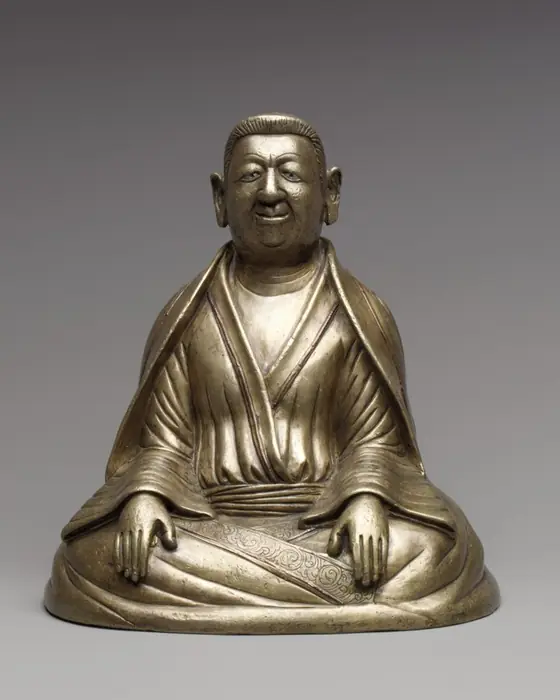
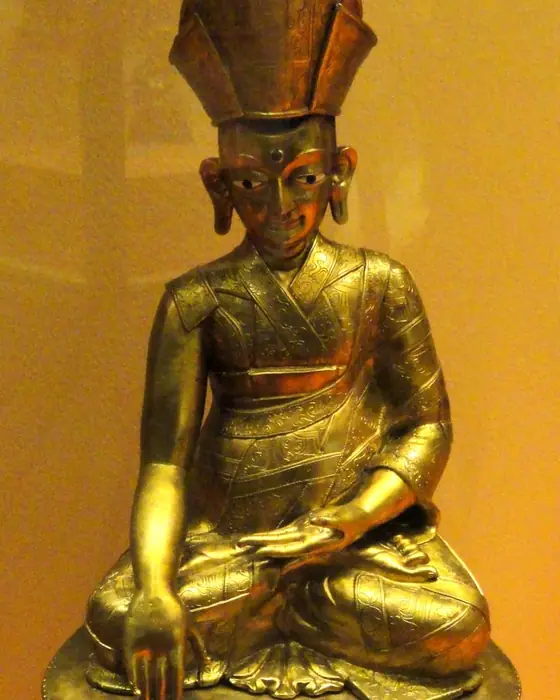
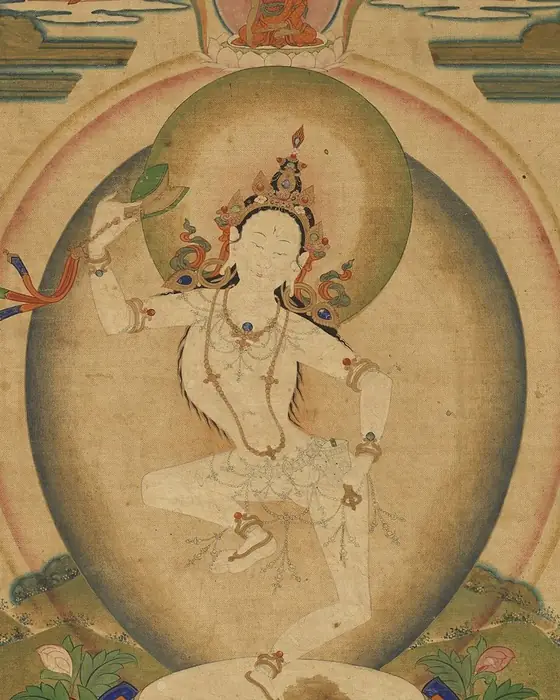
Their story
According to his famous biography, Milarepa was born into a prosperous family in western Tibet. When his father died, his uncle and aunt seized the family's wealth and treated him and his mother as servants. At his mother's urging he learned black magic and, in revenge, brought down a house on a wedding party, killing many people.
Filled with remorse, he sought the teacher Marpa, who for years made him build and tear down stone towers single-handed before at last giving him the teachings. One tower, Sekhar Guthok, still stands in Lhodrak.
He then lived for decades in mountain caves, so poor that he survived on nettles, which, the story says, turned his skin green. He attained awakening, sang his realisation in spontaneous songs and gathered disciples, among them Gampopa and Rechungpa, before his death, tradition says, in 1135.
The world they lived in
Tibet in the 11th and 12th centuries was a land of clans and local lords without a central government, in which new Buddhist lineages were forming around teachers of great personal authority.
Their contribution
He embodied the ideal of the solitary yogi who attains realisation in one life through devotion and effort, and his songs made the deepest teachings of Mahāmudrā accessible in beautiful, simple verse.
Teachings and works
The Hundred Thousand Songs (Mila Gurbum)
Compiled with his biography by Tsangnyön Heruka in 1488.
Related teachings
Their legacy
His story is read, sung and performed across the Tibetan world and has been translated into many languages. Through Gampopa, his teaching became the foundation of the Kagyu monastic schools.
History and tradition
What history can establish
Milarepa is a historical figure, and earlier biographies from the 12th and 13th centuries survive. The famous version most people read was composed by Tsangnyön Heruka, some three and a half centuries after his death, and shaped by his literary art.
What Buddhist tradition remembers
A celebrated episode tells of his contest of magical powers with a Bön master for Mount Kailash, which he won by reaching the summit first, riding on a sunbeam.