Their story
Ashoka was the grandson of Candragupta, founder of the Maurya empire, which at its height covered most of the Indian subcontinent. He came to the throne around 268 BCE; Buddhist chronicles say after a violent struggle for the succession.
About eight years into his reign he conquered the eastern kingdom of Kaliṅga. In one of his rock inscriptions he describes the result himself: a hundred and fifty thousand people carried away, a hundred thousand killed, and many times that number dead. He writes of his deep regret and his new devotion to Dhamma.
For the rest of his reign he had messages carved on rock faces and polished stone pillars across the empire. They urge honesty, compassion, respect for parents and teachers, restraint towards animals and tolerance of all religious groups. They announce medical care, wells and shade trees along the roads, and officials appointed to spread these values. Some speak to Buddhists directly: he records his visit to the Buddha's birthplace at Lumbinī and warns against splitting the monastic community.
The world they lived in
The Maurya empire was the largest state India had yet seen, ruled from Pāṭaliputra and in contact with the Greek kingdoms to the west, whose kings Ashoka names in his inscriptions. Buddhism was one of many religious communities, alongside brahmins, Jains and Ājīvikas, all of whom his inscriptions address.
Their contribution
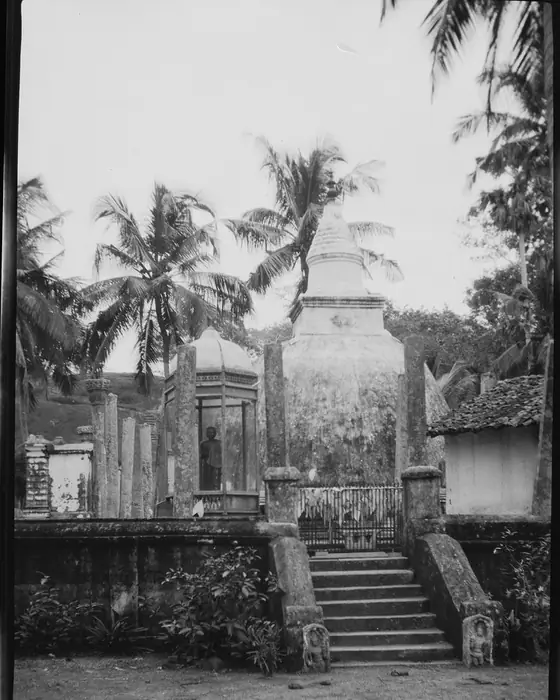
His patronage helped a regional movement become one of India's major religions. Buddhist tradition credits him with building 84,000 stupas, sponsoring a council and sending missions abroad, including to Sri Lanka. His idea of Dhamma as a public ethic of non-violence and care remains a reference point in discussions of ethics and government.
Teachings and works
The Rock and Pillar Edicts
Inscriptions in Prakrit, mostly in Brāhmī script, with versions in Greek and Aramaic in the north-west.
The Minor Rock Edicts
Including one, from Bairāṭ, that recommends particular Buddhist texts to monks, nuns and lay followers.
Related teachings
Their legacy
Buddhist chronicles such as the Mahāvaṃsa and the Aśokāvadāna made him the ideal Buddhist king, a model for rulers from Sri Lanka to Japan. Modern India took the lion capital from his pillar at Sarnath as its national emblem, and the wheel from it for its flag.
History and tradition
What history can establish
Ashoka is one of the best-documented figures of ancient India because of his own inscriptions, whose script was deciphered in the 1830s. They show a ruler personally committed to the Buddha's teaching who nonetheless supported all religious groups. They do not mention Moggaliputta Tissa, a Third Council or Mahinda.
What Buddhist tradition remembers
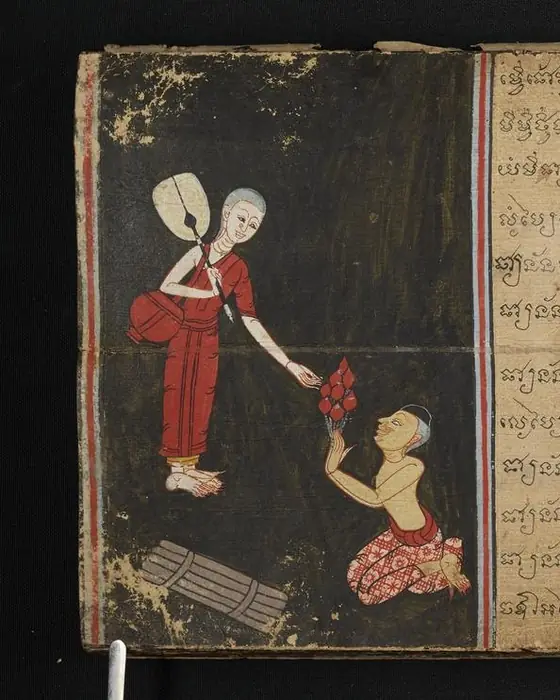
Buddhist tradition tells a more dramatic story: 'Ashoka the Fierce', who killed his brothers and built a hellish prison, is converted by the calm of a young monk and becomes 'Ashoka of the Dharma', who builds 84,000 stupas and sends missionaries across Asia. These accounts were written centuries later and show what Buddhists wanted a Buddhist king to be.