Their story
Tradition holds that Uppalavaṇṇā was the daughter of a merchant of Sāvatthī, named for her skin the colour of a blue lotus. So many suitors sought her that her father, unwilling to offend any of them, suggested she become a nun, and she agreed gladly.
She is remembered as foremost among the nuns in spiritual powers, the female counterpart of Moggallāna, and as one of the Buddha's two chief female disciples.
The commentaries tell that while she lived alone in a forest hut, a man who had long desired her assaulted her. The tradition insists that she was blameless, and says the Buddha afterwards ruled that nuns should not live alone in the forest.
The world they lived in
Early nuns lived with real dangers when they practised alone. The rules that grew up around their safety show a community working out how to protect its members.
Their contribution
Her verses in the Therīgāthā speak of seeing through desire, and her life story shaped the rules by which the nuns' community protected its members.
Teachings and works
Verses in the Therīgāthā (Thig 11.1)
Related teachings
Their legacy
Named in the early texts with Khemā as the ideal for later nuns, Uppalavaṇṇā is honoured throughout Theravāda Asia, sometimes shown with Khemā on either side of the Buddha as the female counterparts of Sāriputta and Moggallāna.
History and tradition
What history can establish
Known only from Buddhist texts. Her verses belong to the early collection; the stories of her life come from commentaries written down centuries later.
What Buddhist tradition remembers
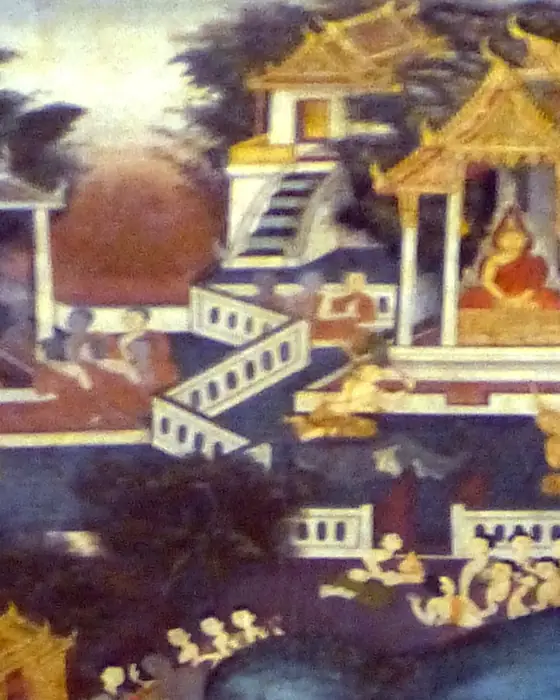
Later tradition tells that she offered to display her powers when rival teachers challenged the Buddha, and, in northern Buddhist sources, that she was the first to greet him when he returned from teaching his mother in the heaven of the thirty-three gods.