Their story
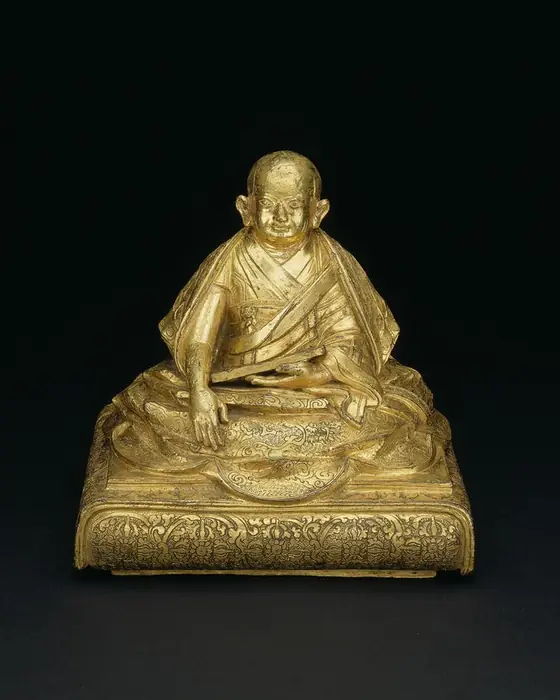
Songtsen Gampo inherited the leadership of a confederation of clans in the Yarlung valley of southern Tibet around 618 and, through conquest and alliances, united the Tibetan plateau into an empire. His death is recorded in the Old Tibetan Annals in 649.
He moved his seat to Lhasa and sought marriage alliances with his powerful neighbours. Chinese sources record that the Tang princess Wencheng was sent to marry into his house in 641. Later Tibetan histories add a Nepalese princess, Bhṛkutī, whose existence is not confirmed by other sources.
In Tibetan tradition, the two princesses brought Buddha images to Lhasa, and the king built the Jokhang and Ramoche temples to house them. Tradition also credits his minister Thonmi Sambhota with creating the Tibetan script from an Indian model.
The world they lived in
In the 7th century Tibet emerged suddenly as a military power between Tang China, the kingdoms of Central Asia, Nepal and India. Its religion was centred on the divine kingship and on local deities of mountain, earth and clan.
Their contribution
He created the Tibetan state within which Buddhism would later flourish, and opened Tibet to the Buddhist cultures of China and Nepal. How personally Buddhist he was is uncertain.
Their legacy
From the 11th century onwards, Tibetan histories celebrated him as the king who first brought the Dharma to Tibet, an emanation of Avalokiteśvara, the bodhisattva of compassion, a role later claimed by the Dalai Lamas. The Jokhang remains Tibet's holiest temple.
History and tradition
What history can establish
His conquests, his death in 649 and the Chinese marriage are documented in early sources. Contemporary Tibetan records say little about his Buddhism; most of the Buddhist story comes from histories written centuries later.
What Buddhist tradition remembers
The Maṇi bka' 'bum, a revealed text from around the 12th century, tells that a ray of light from Avalokiteśvara became Songtsen Gampo, and that the two princesses were emanations of the goddess Tārā.