Their story
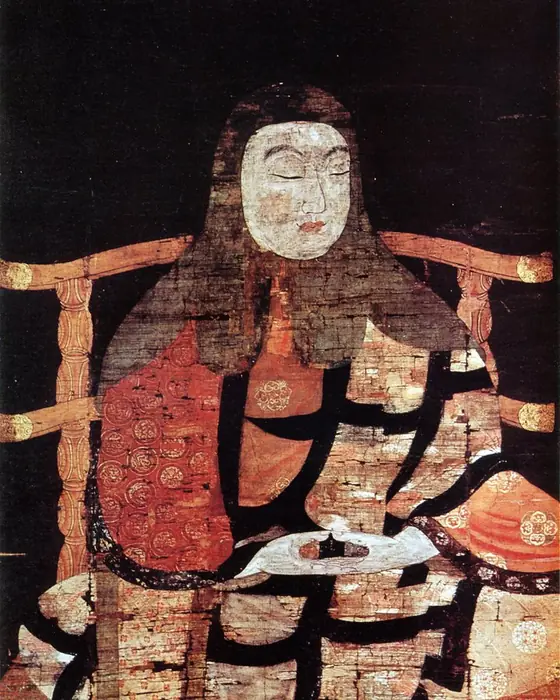
Kūkai was born in 774 on the island of Shikoku into a provincial aristocratic family. He studied at the state academy for officials but left to wander as an ascetic, and at twenty-four wrote a work comparing Confucianism, Daoism and Buddhism.
In 804 he travelled to China with the embassy that also carried Saichō. In Chang'an he met the master Huiguo, who initiated him fully into esoteric Buddhism within a few months, shortly before Huiguo's own death.
Returning in 806 with texts, maṇḍalas and ritual implements, he founded Shingon, 'True Word'. The court gave him Mount Kōya in 816 for a monastery and Tō-ji in Kyoto in 823. He died on Mount Kōya in 835.
The world they lived in
Esoteric Buddhism, with its rituals of mantra, maṇḍala and consecration, was the newest and most prestigious form of Buddhism in Tang China, prized by emperors for protecting the state.
Their contribution
He taught that one can become a Buddha in this very body through the practices of body, speech and mind, and ranked all philosophies in ten stages of mind culminating in the esoteric teaching. He also founded a school open to commoners.
Teachings and works
Jūjūshinron (Treatise on the Ten Stages of Mind)
Sokushin jōbutsu gi (Attaining Buddhahood in This Very Body)
Sangō shiiki (Indications of the Goals of the Three Teachings)
Related teachings
Their legacy
Shingon became one of Japan's major schools, and the pilgrimage of eighty-eight temples on Shikoku, walked in his company according to tradition, is among the world's great pilgrimages.
History and tradition
What history can establish
His life is well documented, and many works and letters in his own hand survive.
What Buddhist tradition remembers
Shingon tradition holds that Kūkai did not die but entered eternal meditation in his mausoleum on Mount Kōya, where monks still bring him meals twice a day, awaiting the coming of Maitreya.