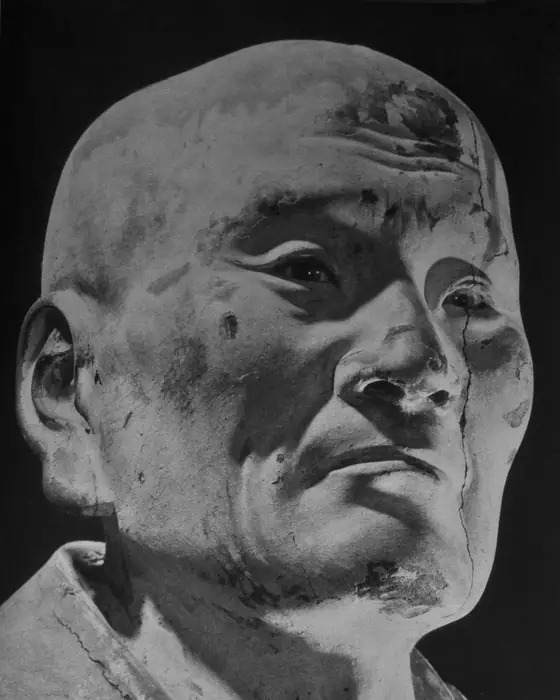
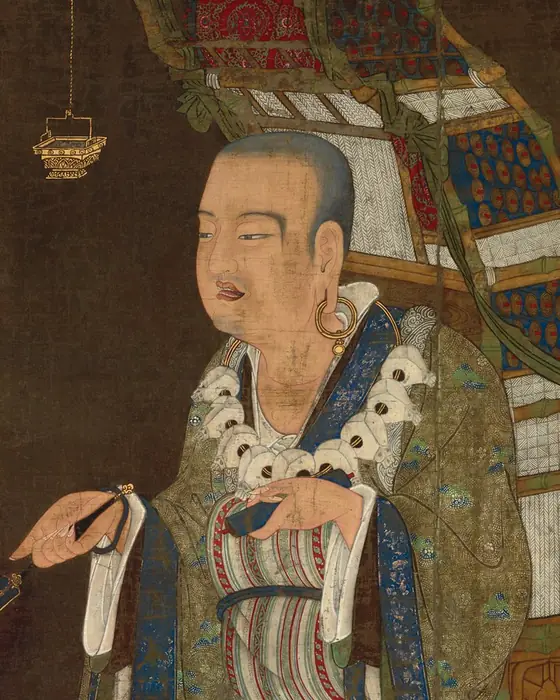
Their story
Tradition, first recorded by the translator Paramārtha in the 6th century, says Vasubandhu was the younger brother of Asaṅga, born in Puruṣapura. He is generally placed in the 4th or 5th century CE.
He first studied the Abhidharma of the Sarvāstivāda school, then the dominant scholastic tradition of north-west India. His Abhidharmakośa, the 'Treasury of Abhidharma', set out that system in verse and then, in his own commentary, criticised it from the more economical standpoint of the Sautrāntikas.
Tradition holds that Asaṅga later persuaded him to embrace the Mahāyāna. He wrote short, brilliant treatises arguing that the world we experience is 'representation only', and commentaries on many Mahāyāna texts. Biographies say he spent his later years at the court of the Gupta kings in Ayodhyā.
The world they lived in
North-west India under the Kushans and then the Guptas was a great centre of Buddhist scholarship, where monks of different schools debated the nature of time, perception and the self with each other and with brahmin philosophers.
Their contribution
He gave Abhidharma its most widely studied form and, as a Yogācāra thinker, gave the doctrine of 'representation only' its sharpest arguments, especially in his Twenty Verses, which argues that an external world is not needed to explain experience.
Teachings and works
Abhidharmakośa and Bhāṣya (Treasury of Abhidharma, with his commentary)
Viṃśatikā (Twenty Verses)
His argument for 'representation only'.
Triṃśikā (Thirty Verses)
A compact summary of Yogācāra, commented on for centuries.
Trisvabhāvanirdeśa (Teaching on the Three Natures)
Traditionally his.
Related teachings
Their legacy
The Treasury was translated into Chinese twice and remains a standard textbook in Tibetan monasteries and in the Japanese Kusha school. The Thirty Verses, with commentaries compiled by Xuanzang, became the basis of Chinese and Japanese Yogācāra.
History and tradition
What history can establish
Scholars have long debated whether the Abhidharma scholar and the Yogācāra author were the same person; the Austrian scholar Erich Frauwallner proposed there were two Vasubandhus. Many now accept one, but his dates remain uncertain.
What Buddhist tradition remembers
A story tells that on hearing Asaṅga's teaching he wanted to cut out his own tongue for having criticised the Mahāyāna, and Asaṅga told him to use the same tongue to praise it instead.