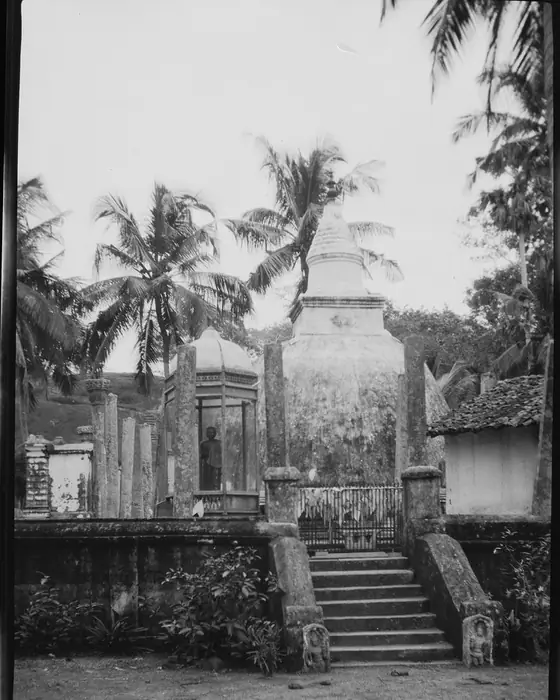
Their story
Buddhaghosa's own writings say little about his life. The Cūḷavaṃsa, a continuation of the Sri Lankan chronicle written some centuries later, says he was a learned brahmin from near Bodh Gaya who became a Buddhist monk and travelled to Sri Lanka in the reign of King Mahānāma, in the early 5th century, to study the commentaries preserved there in Sinhala.
According to the chronicle, the monks of the Mahāvihāra tested him with two verses. In reply he wrote the Visuddhimagga, the 'Path of Purification', a systematic summary of the whole teaching organised as ethics, concentration and wisdom. Satisfied, they gave him the Sinhala commentaries, which he rendered into Pāli.
The commentaries on the monastic discipline and on the four main collections of discourses are attributed to him. Tradition says he then returned to India.
The world they lived in
By the 5th century, the Pāli canon had been written down in Sri Lanka for some four hundred years, but its explanations circulated in Sinhala, unreadable to monks elsewhere. The Mahāvihāra was competing with the rival Abhayagiri monastery, which was open to Mahāyāna influences.
Their contribution
He made the Mahāvihāra's interpretation of the canon available in Pāli, the international language of Theravāda, and gave it a comprehensive, systematic form. His meditation manual describes forty subjects of meditation and the stages of insight in great detail.
Teachings and works
Visuddhimagga (The Path of Purification)
His own summary of the teaching.
Samantapāsādikā
Commentary on the monastic discipline.
Commentaries on the Dīgha, Majjhima, Saṃyutta and Aṅguttara Nikāyas
Commentaries on the Abhidhamma
Traditionally attributed to him; some scholars question his authorship.
Related teachings
Their legacy
His commentaries defined Theravāda orthodoxy in Sri Lanka, Myanmar, Thailand, Cambodia and Laos. Modern meditation movements, including the Burmese insight traditions, draw directly on the Path of Purification.
History and tradition
What history can establish
His works are real and securely attributed in part; his biography rests on a chronicle written long after. Burmese tradition claims he came from Thaton in lower Myanmar, a view scholars do not accept.
What Buddhist tradition remembers
Later legends made him an incarnation of a god, and say the gods twice hid his manuscript of the Path of Purification so that he had to write it three times, each copy identical.